


Predictive fall prevention

Predicting falls before they happen.

Haven uses passive in-home sensing and wearable intelligence to detect subtle changes in how your loved one moves — weeks before a fall occurs. No pendants. No buttons to press.

"Where home feels safe again."
An older woman smiling peacefully in her sunlit living room
The scale of the problem
14M
Adults 65+ fall every year in the U.S.
$80B
Annual healthcare cost of non-fatal falls
41k+
Annual deaths from falls, adults 65+
95%
Haven's gait-analysis sensitivity
The problem

Falls are the #1 killer of older adults. Current solutions only react.

By the time a fall happens, the window to prevent it has already closed. Every existing product works the same way — wait for someone to hit the ground, then send an alert. Meanwhile 1 in 4 seniors fall every year, fall-death rates have surged +41% since 2012, the average fall-related ER visit costs $18,658, and 67% of those costs are paid by Medicare — which has every incentive to fund prevention over treatment.

How the category works now

  • Wearable panic buttons users forget or refuse to wear
  • Camera systems that invade privacy
  • Motion sensors that can't tell a fall from sitting down
  • All react after the damage is done

How Haven works

  • Passive plug-in sensors — nothing to wear, nothing to press
  • Works alongside the watch they already own
  • Detects gait deterioration weeks before a fall
  • Predicts and prevents — not just detects
Who Haven is for

Every home we protect has a story.

Haven is built for every kind of aging-in-place family — across generations, cultures, and homes. These are the families we're building it for.

"Mamá won't admit when her hip hurts. Last month Haven flagged her walking speed dropping for four days straight — I called her that night and we got her to PT before the next flare."

Daughter of Abuela Rosa · Phoenix, AZ
The science

Fall risk does not appear suddenly.

Measurable gait deterioration shows up two to six weeks before a fall — reduced walking speed, shortened stride, increased step-to-step variability. The data is there. What's been missing is a consumer platform that collects it continuously and actually acts on it.

Gait speed is now recognized in geriatric medicine as the sixth vital sign. Walking speed below 0.8 m/s predicts not only falls but also cognitive decline, hospitalization, and mortality.

Modern machine-learning models analyzing temporal gait features from a single walking cycle achieve 93.6% classification accuracy for fall risk in elderly populations. Haven's approach synthesizes data from environmental sensors, wearable accelerometers, and optional vision systems — building a more complete movement profile than any single-modality system.

Measurable gait deterioration — reduced walking speed, shortened stride length, increased step asymmetry — can be observed 2 to 6 weeks before a fall event. Gait & Posture, 2023

The changes are often imperceptible to family members — and to the individual experiencing them. But they are measurable by sensor systems operating continuously, twenty-four hours a day.

93.6%
Fall-risk classification accuracy from temporal gait features in a single walking cycle.
Frontiers in AI · 2024 →
2–6 wk
Early-warning window in which gait deterioration is detectable before a fall.
Warning signs research →
0.8 m/s
The clinical gait-speed threshold — below which fall, cognitive, and mortality risk rise sharply.
Gait speed & aging →
78%
Of in-home falls occur in just three rooms: bedroom, bathroom, kitchen.
Economic burden →
The ecosystem

Five platforms. One unified system.

Hardware you place, software you carry — and nothing leaves the home.

In the home
Steadfast
Plug-in sensor
Passive room-scale monitoring. No wearables, no cameras.
Vigil
Vision · optional
Privacy-tiered computer vision for real-time gait analysis.
Stride
Wearable overlay
Works with the Apple Watch, Fitbit, or Garmin they already own.
At the edge
Anchor
Edge compute hub
All sensor data processed locally. Only derived insights travel outward.
Raw data never leaves home.
To the family
Beacon
Family dashboard
Risk score, gait trends, and contextualized alerts — on the phone of whoever cares.

Three devices in the home. One hub at the edge. One dashboard for the family. Five platforms, zero raw-data egress.

Haven Steadfast sensor — faceted brushed-gold plug-in device with green status light
Steadfast
Passive in-home sensor

RF-based presence and gait sensing — no cameras, no microphones. Plug it in; it learns the rhythms of the home.

  • Wi-Fi CSI radio-frequency sensing
  • Works through walls; covers bedroom, bath, kitchen
  • Zero compliance — no wearable, no button, no setup
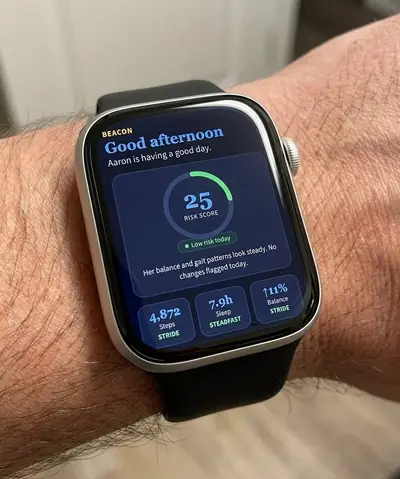
Apple Watch displaying the Haven Beacon dashboard: Risk Score 25, steps, sleep, balance
Stride
Wearable overlay

Turns the Apple Watch, Fitbit, or Garmin they already wear into a continuous gait-baseline engine. No new hardware.

  • Personalized gait fingerprint over 4 weeks
  • Detects stride, cadence, and balance drift
  • The signal layer that makes prediction possible
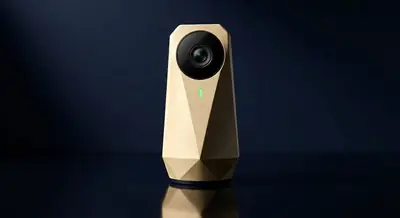
Haven Vigil camera — faceted brushed-gold unit with wide-angle black lens
Vigil
Vision · optional

Computer-vision pose estimation for higher-risk situations. Privacy-tiered and entirely family-controlled.

  • Most data-rich monitoring available
  • Micro-movement other sensors can't see
  • Opt-in only — families choose the privacy tier
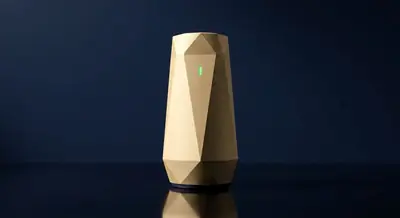
Haven Anchor edge-compute hub — tall faceted brushed-gold device
Anchor
Edge compute hub · Matter-compatible

The nervous system. Every signal processed locally; only derived insights ever leave the home.

  • Raw data never transmitted to the cloud
  • Matter-native: Apple Home · Google Home · Alexa
  • TLS 1.3 in transit · AES-256 at rest
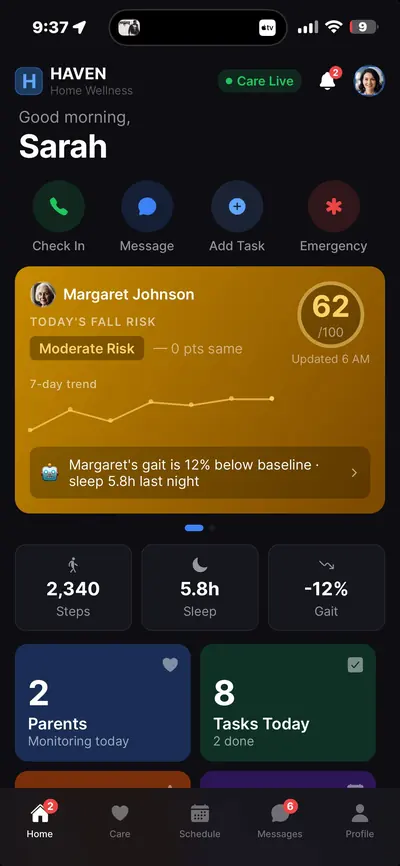
Haven Beacon family dashboard on iPhone — Margaret Johnson's fall risk score of 62 out of 100, 7-day trend, and steps, sleep, and gait summary
Beacon
Family dashboard

What families see every day. A single daily risk score, contextualized alerts, and a weekly health narrative — in plain English.

  • One score · zero clinical jargon
  • AI-written explanations of what changed and why
  • On the phone of whoever cares, wherever they are
How prediction works

From a baseline to a warning — weeks before a fall.

Haven doesn't just watch for events. It learns your loved one's personal rhythm, then watches for the drift.

1
Weeks 1–4

Contextual baseline

Stride passively observes how they walk — speed, cadence, symmetry, arm swing — and builds a gait fingerprint unique to them.

2
Ongoing

Invisible monitoring

Every walk through the home is compared against the baseline. No cameras. No wearables beyond the watch they already own.

3
Early warning

Degradation detected

Stride length shortens 8%. Walking speed drops 0.15 m/s over three weeks. Left-right asymmetry increases. Too subtle for clinical observation. Haven sees it.

4
Intervention

The fall never happens

Beacon alerts the caregiver. Physical therapy is ordered. Home modifications are made. The ER visit that would have cost $18,658 never occurs.

An adult daughter at home, looking at the Haven Beacon app on her phone
For the family

A small notification, weeks before a big fall.

Beacon delivers a risk score and plain-English context — not a flood of raw data. You'll know when something is drifting, what's driving it, and what to do next.

No more guessing whether that one recent stumble was a fluke or a pattern. Haven sees the pattern.

"Mom is walking steadier this week — but she's taking longer in the bathroom at night. Worth a call."
Peer-reviewed evidence

Validated by the research. Not the marketing.

Haven's architecture is rooted in a robust body of peer-reviewed work on sensor-based human-activity recognition and gait-based fall prediction.

98%
Fall-detection accuracy using mmWave radar with semi-supervised learning.
mmFall · IEEE Trans. Automation
96%
Gait step-time measurement accuracy mapping FMCW radar in real environments.
PMC / Sensors · 2022
>90%
Activity-recognition accuracy across 8 unique environments using Wi-Fi CSI.
EHUNAM · Nature Scientific Data
125
Diverse volunteers tested (ages 6–63), validating the mmWave gait ecosystem.
RDGait · ACM UbiComp · 2024
1.2TB
Public CSI+BFI dataset spanning 20 activities across complex NLOS scenarios.
CSI-BFI-HAR · IEEE DataPort
93.6%
Machine-learning classification accuracy from a single walking-cycle gait signature.
Frontiers in AI · 2024
Regulatory & reimbursement

A clear path through FDA and Medicare.

Haven's clinical vision module and remote-monitoring model are built on regulatory precedents already set by radar-based health monitors on the market.

FDA 510(k)

Substantial equivalence pathway

Xandar Kardian's XK300 — a radar-based contactless vital-sign monitor — received FDA 510(k) clearance as a Class II medical device in April 2021. Haven's Stride engine uses a related RF modality for a complementary application.

This positions Haven for expedited clearance through the identical substantial-equivalence pathway. 510(k) is additive upside — not a gating dependency for consumer launch.

Medicare RPM

CPT 99454 · 99457 · 99458

Similar RF technologies already qualify for Medicare reimbursement under Remote Physiologic Monitoring codes. Once Haven achieves clearance, the same pipeline activates.

The core customer does not pay out of pocket — Medicare does. Haven aligns with Medicare's multi-billion-dollar incentive to fund prevention over treatment.

About Haven

Two founders. One mission.

Haven exists because falling shouldn't be an inevitability of aging. With the right technology — passive, predictive, and privacy-preserving — we can see risk before it becomes injury, and do it without cameras, wearables, or compromising anyone's dignity.

Privacy by design

No cameras. No microphones. No cloud-first architecture. Haven processes data at the edge and only transmits anonymized, derived insights. Privacy isn't a feature — it's the foundation.

Science over hype

Every claim we make is grounded in peer-reviewed research. RF-based gait analysis, predictive fall-risk modeling, and passive sensing are validated technologies — not vaporware.

Dignity first

Aging adults aren't patients to be monitored. They're people who deserve to live independently, safely, and with full agency. Our technology is invisible because their life is what matters.

Incorporation
Delaware C-Corp
Founded
2025
Stage
Pre-seed
Headquarters
Leesburg, VA
Leadership

The founding team.

NW

Nick Whitehead

Co-Founder & CEO

Business development professional with deep experience in enterprise SaaS sales and AI-powered marketing technology. Currently at Typeface, navigating complex enterprise sales cycles and driving AI adoption with Fortune 500 decision-makers.

Brings a maker's mentality to product development — hands-on hardware prototypes, software tools, and AI agents. Responsible for Haven's business strategy, fundraising, go-to-market execution, and investor relations.

DT

David A. Taylor

Co-Founder & CTO

Technical co-founder responsible for Haven's RF sensing architecture, firmware development, AI/ML pipeline design, and cloud infrastructure. Leads engineering across the Steadfast sensor array, the Stride analytics engine, and the Vigil clinical dashboard.

Owns the complete hardware-to-software pipeline — from sensor selection and embedded systems design through edge compute optimization and cloud-scale data processing.

Pricing

Four tiers. One ecosystem. Pay for what fits.

Every tier includes the Anchor hub and the Beacon family dashboard. Start light. Expand as needs change.

Essential
$29.99/mo
Passive sensing & the family dashboard.
  • Steadfast plug-in sensors
  • Beacon family dashboard
  • Anchor edge hub included
  • Weekly health narrative
Premium
$59.99/mo
Full data-richness for higher-risk situations.
  • Everything in Plus
  • Vigil computer-vision layer
  • Real-time posture analysis
  • Privacy-tiered, family-controlled
Family
$79.99/mo
Multi-senior households & extended care.
  • Everything in Premium
  • Multiple monitored adults
  • Shared family Beacon access
  • Priority clinical support
Questions

The things families ask us most.

What makes Haven different from Life Alert or Apple Watch fall detection?

Life Alert, Medical Guardian, and Apple Watch all detect falls after they happen — they're reactive. Haven is predictive. It monitors subtle changes in gait, movement patterns, and daily routines to identify rising fall risk weeks before a fall occurs.

Haven also requires zero compliance from the senior: no pendants to wear, no buttons to press, no devices to charge or remember.

Does Haven use cameras in my parent's home?

Haven's core system — Steadfast sensors, Stride wearable overlay, Anchor edge hub, and Beacon dashboard — uses no cameras whatsoever. Vigil is an optional computer-vision module for higher-risk situations, and it is entirely family-controlled and privacy-tiered.

All data processing happens locally on the Anchor hub inside the home. Raw data never leaves the premises.

How accurate is gait-based fall prediction?

Peer-reviewed research demonstrates AI models analyzing gait parameters achieve 90–95% sensitivity in identifying individuals at elevated fall risk. A 2024 study in Frontiers in Artificial Intelligence reported 93.6% accuracy using temporal gait features from a single walking cycle.

Haven's multi-sensor approach — combining environmental, wearable, and optional vision data — is designed to exceed single-modality accuracy by building a more complete movement profile.

Who is Haven designed for?

Haven is designed for adult children caring for aging parents who want to live independently. The senior is the monitored individual, but the primary buyer and daily dashboard user is the family caregiver — typically a 45-to-65-year-old professional managing care from a distance.

Haven provides peace of mind without disrupting the senior's independence or dignity.

When can I get Haven?

Haven is in active development and launching in 2026. Waitlist members get first access to pilots, founding-family pricing locked in for life, and direct access to our clinical team during the pilot phase.

Is this a medical device?

The consumer product is a wellness platform, not a diagnostic device. Vigil is being pursued on an FDA 510(k) pathway as a Class II medical device for use in higher-acuity and institutional settings, using the BioSensics LEGSys as the predicate. FDA clearance is additive upside — not a requirement for consumer launch.

Get in touch

Let's talk.

Questions, partnerships, press, or investor inquiries — we read everything. We guarantee a response directly from the founders within one business day.

  • For families — learn more about pilots launching in 2026
  • For clinicians & senior living operators — discuss pilot partnerships
  • For investors & press — request the pitch deck or white paper

Haven Home Wellness, Inc. · Delaware C-Corp
Leesburg, VA · info@havenhomewellness.ai

Three generations of a family sitting together on a couch in warm evening light